
Delivery tracking across client accounts
Know whose move it is.
Elsagility is a delivery tracker for teams running the same sequence across a whole portfolio of clients at once. It is fed by your calls, and it separates what you owe from what you are waiting on.
- Work you own
- Typed actions, dated from the playbook. Late means late.
- Work they own
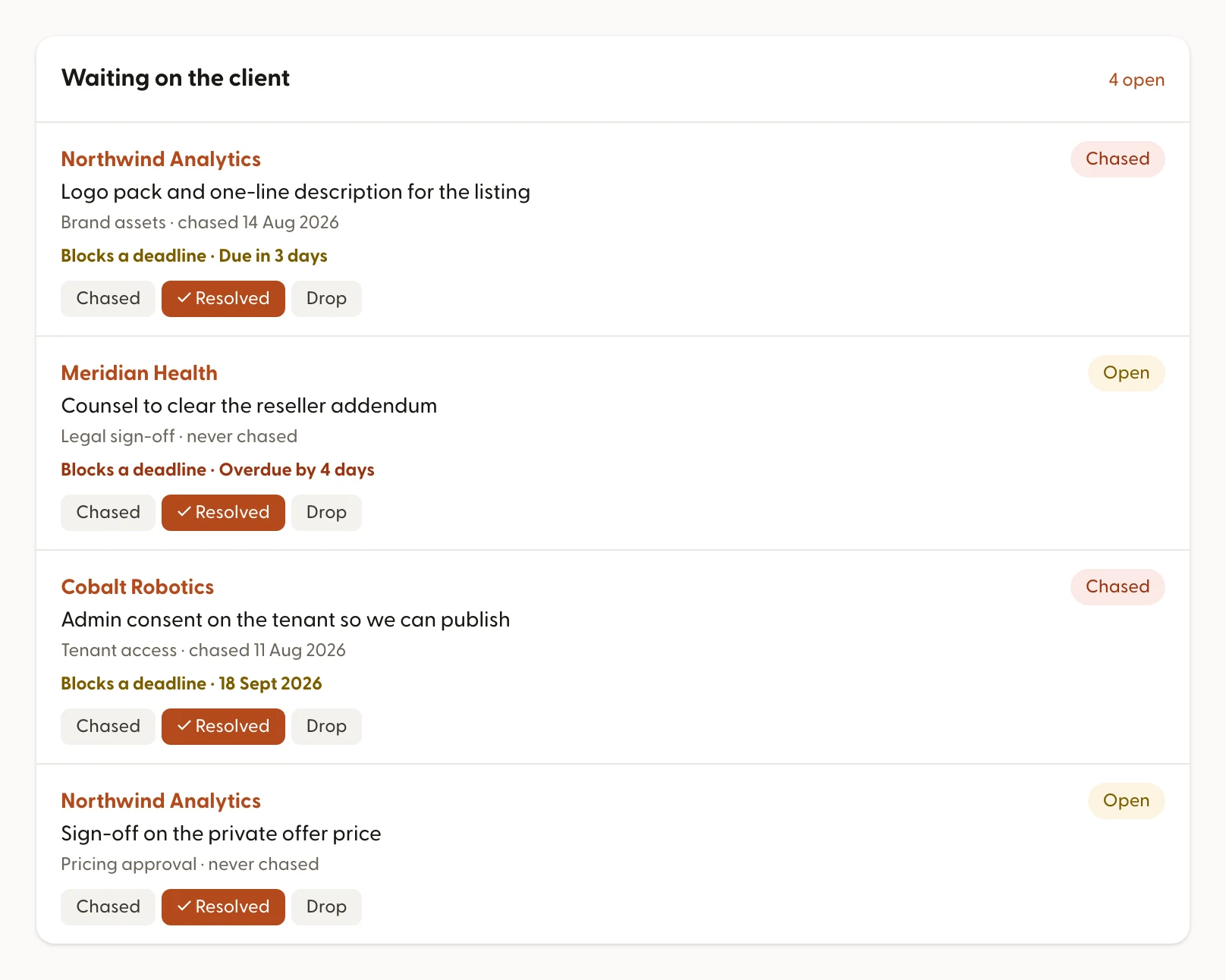
- Blockers, with a chase clock and the deadline they endanger. Not late until you have asked.
A tracker that never cries wolf
Every account has its own answer, and none of them live in the same place.
Run a portfolio through the same sequence and “where are we?” stops having one answer. It has one per account, they all move independently, and not one of them is written down next to the others.
Half the work is not even yours: brand assets, admin access, a legal sign-off, a reply from a third party. You can neither do it nor forget it.
So tools in this category fail in one of two directions. They mark everything late, including what is legitimately sitting with someone else — or they say nothing at all while a client deadline goes past. Both end the same way: the real answer moves back into your head, and the tracker becomes a thing you update after the fact to make it agree with you.
What the model does about it
The playbook writes the plan
A new client inherits a dated sequence from a template, relative to their start date. You stop retyping nineteen steps per account.
Waiting is its own object
Not a status on a task. A blocker carries an owner on the client side, the business deadline it endangers, and a chase clock. Until you have actually asked, it does not count as outstanding.
Your calls do the data entry
Paste a transcript from a client call or an internal one. Elsagility proposes the updates, each quoting the line that justifies it. You accept or reject. Nothing is written any other way.
How it works
Four things, in the order you would actually do them.
01
Bring a client in from a playbook
Pick the sequence you already run — onboarding, a co-sell launch, a renewal push — and give it a start date. Every step lands dated, and every step lands with a side that owns it. You stop retyping nineteen tasks per account.
02
Run the week from one list
What you owe, sorted by when it is actually due. What you are waiting on, sorted by how long it has been sitting. These are separate lists because they demand different actions: one is work, the other is a nudge.
03
Paste the call, review the proposals
After a client call or an internal one, paste the transcript. Elsagility proposes completions, updates and new blockers, each quoting the line that justifies it and naming who said it. You accept or reject, item by item.
04
Answer “where are we?” without opening six tabs
One account, its workstreams, the sequence, and whose move each step is. The answer is on the screen rather than reconstructed from memory, a spreadsheet and a thread.
Who it is for
Teams whose work repeats, and whose clients do not cooperate on schedule.
The value compounds with the number of accounts running the same sequence at once, because every account you add multiplies the number of places an answer could be hiding. One does not need this. Forty do, and so does anyone who has ever been asked for a status update and had to go and find out.
Partnership and alliance teams
Running the same certification, listing or co-sell motion across a portfolio of software vendors, where half of every step depends on the vendor and the other half on a platform.
Onboarding and delivery teams
Taking new clients through a fixed sequence, where the sequence is genuinely fixed but the dates, the owners and the stalls are different every time.
Small consultancies with repeating engagements
Ten to a hundred live accounts, no dedicated project manager, and a shared inbox that is currently doing the job of a tracker.
Questions
The things people ask on the first call.
- How is this different from a project management tool?
- Most trackers have one object called a task and a field called assignee. Elsagility splits work you own from work someone else owns into two different objects, because they behave differently: a task is late when you have not done it, a blocker is only outstanding once you have actually asked. That distinction is the product.
- Does the AI change my data?
- No. Every AI-derived change lands in a review queue and is applied by a person. There is no auto-apply, and no setting that turns one on. Model confidence sorts the queue and nothing else — it never authorises a write.
- What stops it inventing a quote?
- Each proposal must carry a verbatim extract from the transcript you submitted, plus the speaker. The extract is checked mechanically against that transcript. A proposal whose quote is not found is discarded before it reaches your queue, so a fabricated one cannot be accepted by mistake.
- Do I have to record my calls?
- No. Ingestion takes pasted text, so any source works — your own notes from the call, a summary someone sent you, a transcript from whatever tool you already use. Nothing is recorded by Elsagility.
- What happens to a client that goes quiet?
- The blocker keeps its chase clock and stays attached to the business deadline it endangers, so a stall surfaces as “this launch date is now at risk” rather than as an overdue task nobody can action.
- Can I change the playbook after clients are running on it?
- Yes. A playbook is a template, and instantiating it produces an independent dated sequence. Editing the template shapes the next client rather than rewriting the history of every account already running on it.
Request a demo
See it against a sequence like yours.
We are opening Elsagility to a limited number of teams first. Tell us how many clients you run and what breaks today, and we will show you how it works.
A real person reads this and replies, usually the same or next working day. If you would rather just write to us, the address is on the contact page.